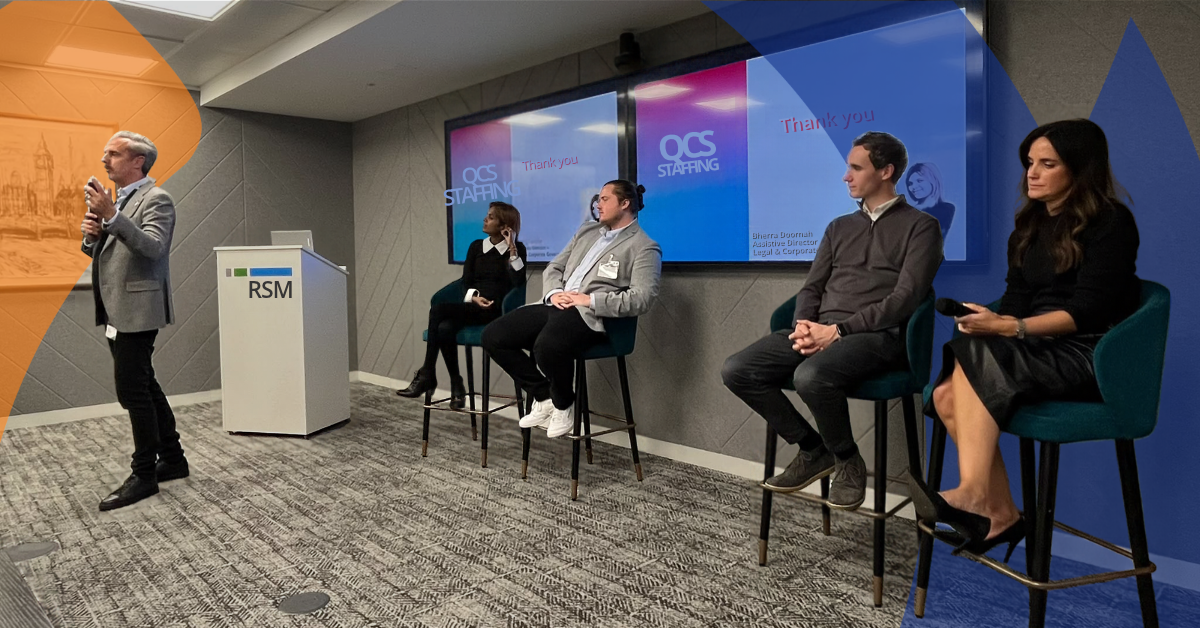
On Tuesday 10 November, APSCo members gathered at RSM’s London offices for the latest International Forum. The brief was to explore compliance as a driver of growth rather than a constraint, and the speakers made a convincing case.
Our thanks to RSM for hosting, to Workwell Global for sponsoring, and to Spencer Trigg of QCS for chairing.
International is now the baseline
International hiring has moved from differentiator to expectation. Spencer referenced forecasts that the global contingent opportunity is forecast to grow by around US$240bn over the next 5-7 years, reaching almost US$480bn by 2032.
Amy Davies and Will Pendleton of Workwell Global noted that at least half the room already placed in more than one market, and that 49% of senior HR leaders say attracting and retaining international talent is very challenging, citing operational complexity as the main concern.
Clients want international talent and find it hard to get. That gap is where well-run compliance becomes a selling point.
The US dominated the discussion. Workwell shared that the US holds around 30% of the global staffing market against the UK’s 8%, with significant demand for professional staff in California, Texas, Florida and New York and shifting towards the East Coast. In Europe, they reported growing demand in the Nordics (driven by data centre builds), Spain, Germany and Italy.
Worker classification: practice beats paper
The sharpest warning was that contracts alone will not protect you.
Three US case studies illustrated why:
- FedEx Ground: around 2,500 drivers were ruled misclassified as independent contractors, ending in a $230 million settlement. Uniforms, prescribed procedures and GPS-directed routes outweighed the fact that drivers paid for their own fuel and equipment.
- Power Design: a $4 million settlement, around $2 million of it penalties, where liability extended to several parties in the supply chain that had failed in their due diligence.
- An ongoing UK case with potential exposure of around 240 million, where the argument turns on working practices rather than contract wording.
In the Q&A, the panel explained that US investigations often begin with a worker’s unpaid wages claim to the Department of Labor rather than a classification audit. Investigators can then look back across the whole contract and every worker at that client, and every party in the supply chain can be called to account. Exposure covers unpaid tax, sick and holiday pay, overtime and penalties, before any reputational damage. A framework sales teams can use.
A recurring theme was that compliance should equip sales teams, not slow them down.
Practical advice included:
- Define approved countries and engagement models, and set client onboarding criteria.
- Document your risk appetite by country, for example a cap on the share of independent contractors on your books.
- Use a decision matrix so consultants know the red flags before a deal is agreed.
- Spell out in contracts who is responsible for what, including supervision, direction and control.
- Use partners as “stabilisers” when entering a new market, then bring capability in-house as confidence grows. Workwell shared an example of a UK agency that grew into an 11-office US business this way.
Amy also linked compliance to enterprise value: when she sold her own business in 2024, she said she spent more time discussing compliance than sales with the six private equity firms she met.
E-invoicing: the next wave of mandates
Jack Hadingham from RSM explained that e-invoicing means moving from invoices as visual documents to structured, machine-readable data exchanged over a network and, in some countries, shared with tax authorities in near real time.
- UK: from 1 April 2029, all UK-registered businesses will need to issue and receive e-invoices for B2B and B2G transactions. A technical consultation starts in spring 2027, with detailed requirements due between October 2027 and April 2028.
- Elsewhere: Belgium, Poland and France have gone live this year, with more mandates due in 2027, and no two countries work the same way.
- His advice: understand your requirements before choosing a provider, give the project clear internal ownership, check your master data and system integrations, and start now.
A practitioner’s view from QCS
Bhavna Dooman of QCS shared lessons from operating across 30 countries, using Germany as a case study. Worker classification, employee leasing, social security, registrations and even postal timelines for signed documents all add complexity. Their approach: check, double check and involve in-country experts, engage compliance from the start of a deal, keep audit-ready records, and be solution-driven rather than the bottleneck.
Takeaways
-
- Compliance wins work. Clients struggle with international complexity, so agencies that solve it have an edge.
- Working practices beat contracts. Look at how workers are treated day to day.
- Know your risk appetite. Document it by country and give sales a framework to sell within.
- Treat the US as 50 markets. The panel were clear that scaling there generally means engaging both employed and independent workers compliantly, or walking away from deals.
- Count the hidden costs. Employee leasing in Germany and a work permit in Italy were both described as far costlier and slower than expected.
- Prepare for e-invoicing now. Timelines are long and requirements still move.
- Make the internal case with evidence. Bring research, a proposed playbook and the commercial upside, and know your exit point.
Thank you to everyone who joined us and to our speakers for their candour. If you’d like to discuss any of this, or suggest topics for a future forum, get in touch with the APSCo team.